Growth
Why Has B2B Growth Flattened? Breaking the Scale-Up Plateau
When B2B growth slows, doing more is not automatically the answer. Diagnose whether the constraint sits in your channels, market, execution or product before spending harder.
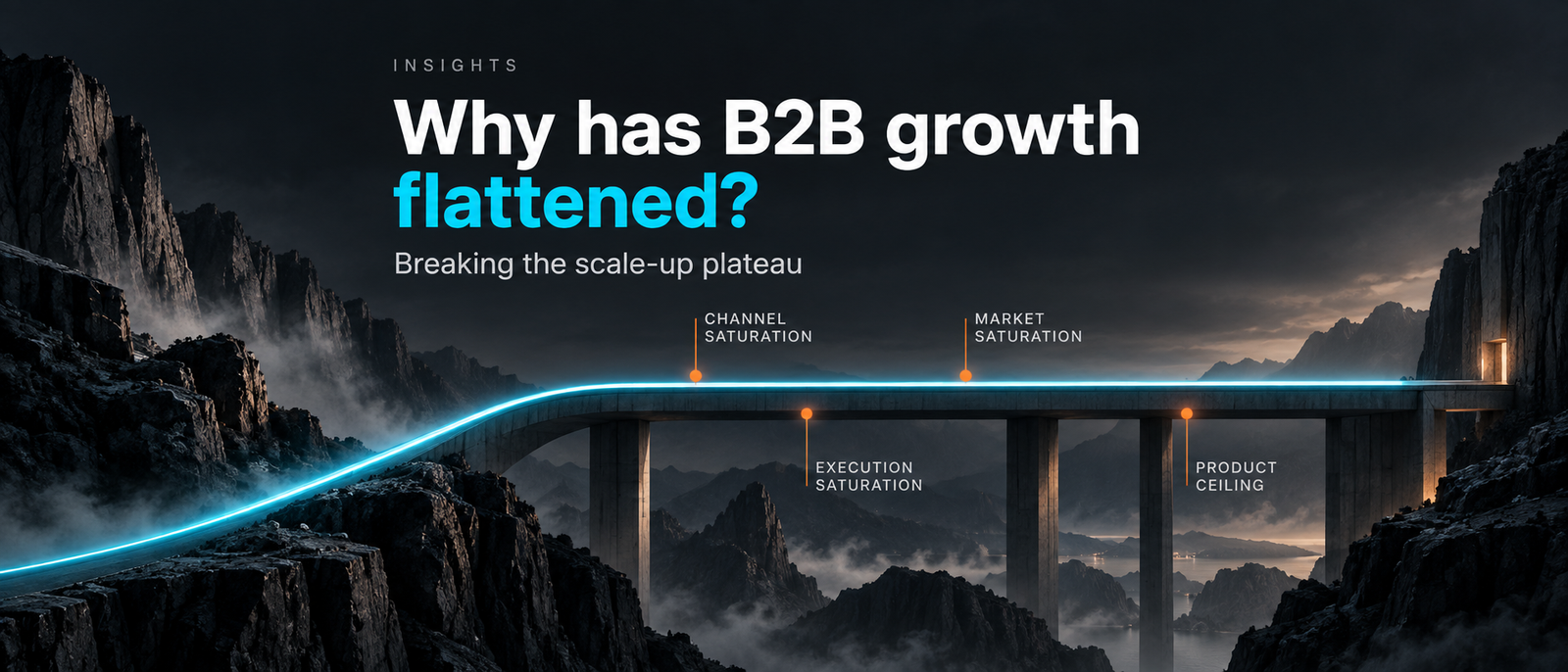
When growth slows, businesses tend to respond by doing more. More campaigns, more channels, more salespeople, more outbound and more content.
Sometimes that works. But if the constraint isn't a lack of activity, increasing activity simply pushes more money through the same constraint.
Before deciding how to grow again, you need to understand what stopped the existing growth engine from working.
Growth doesn't slow: one of four things breaks
A growth plateau can usually be investigated through four broad constraints.
- Channel saturation means the channels that produced efficient growth are becoming less productive.
- Market saturation means you're struggling to find enough additional customers within the segment you've been successfully serving.
- Execution saturation means demand exists, but your organisation can no longer convert or deliver it efficiently.
- Product ceiling means the offer itself is restricting further growth through weak differentiation, adoption, retention, expansion or value.
They can look remarkably similar in the headline numbers. Revenue growth slows, CAC increases and pipeline coverage falls. The response should be completely different depending on which constraint is responsible.
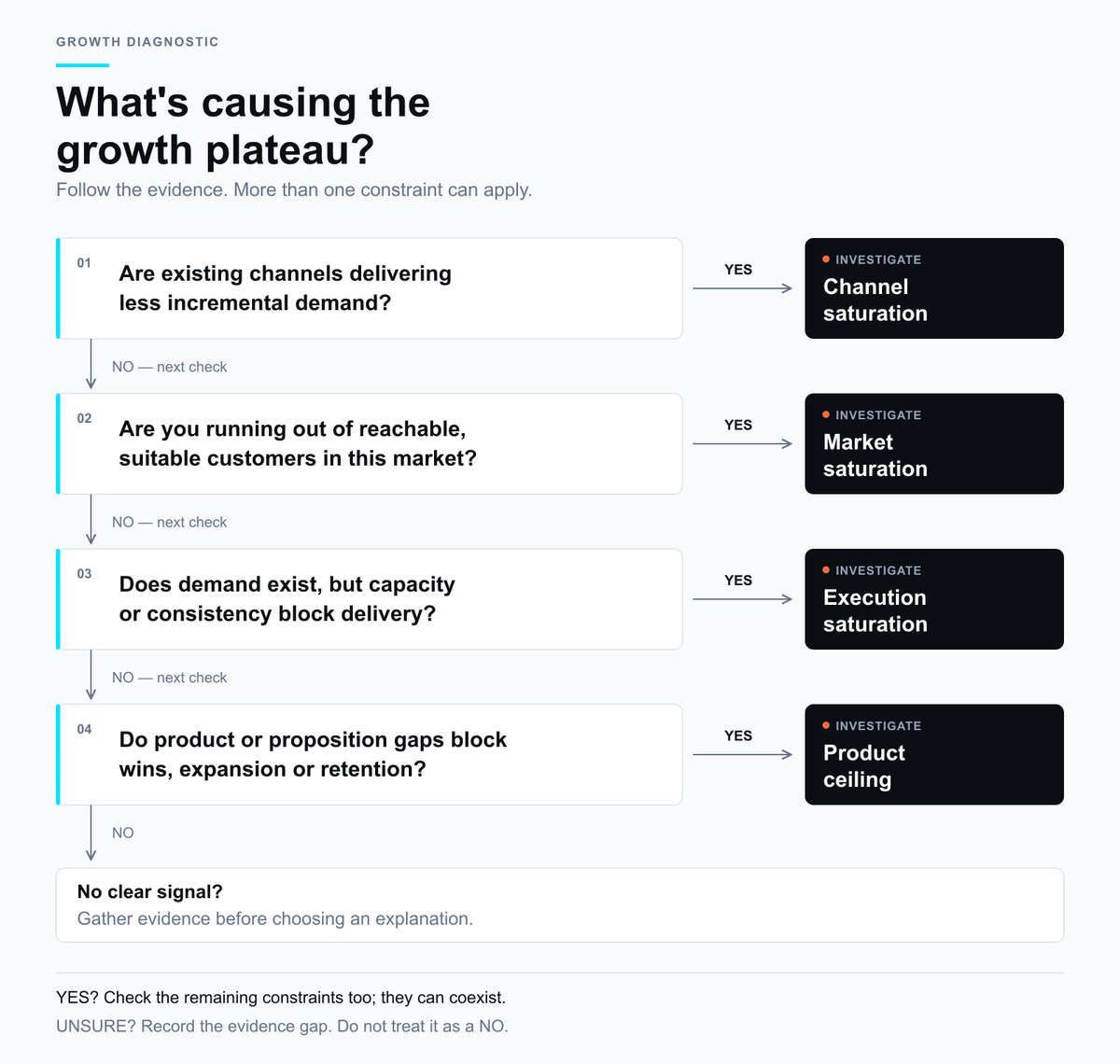
Channel saturation vs market saturation vs execution saturation
Start with where performance changed. If one acquisition channel is deteriorating while downstream conversion remains healthy, investigate the channel. You may be reaching diminishing returns, facing greater competition or simply exhausting the audience available through that route.
If multiple channels still generate engagement but increasingly struggle to find enough high-fit prospects, look at the market and ICP. If demand remains healthy but opportunities are progressing more slowly, win rates are declining or capacity is becoming constrained, look inside the commercial operation.
The important thing is to follow the evidence through the system. Don't diagnose a top-of-funnel problem using a revenue number.
Revenue is the outcome. The constraint may sit several stages earlier.
When you've maxed out your ICP
A business can execute extremely well and still hit a ceiling. Imagine you've built a strong position within a particular segment. Awareness is good. Your sales team knows the buyer. Marketing has reliable channels. Customer references are strong.
Eventually the pool of genuinely attractive new customers can become harder to expand. That doesn't necessarily mean the existing ICP was wrong. It may mean it worked.
The question then becomes whether there is enough headroom within the existing market to support the next stage of growth. Before expanding, look at penetration, remaining addressable accounts, win rates, retention, expansion revenue and whether the economics remain attractive as you move further away from your strongest customers.
That determines whether you need to improve the current engine or build another one.
The second growth engine playbook
A second growth engine doesn't simply mean adding another marketing channel. It means creating another repeatable source of commercially attractive growth.
That could be a new customer segment, geography, proposition, product, partner motion or route to market. The important word is repeatable.
If the existing business grew through founder relationships, for example, hiring an SDR isn't automatically a second engine. You've added a role, not necessarily created a repeatable growth system.
Treat a new engine as a hypothesis. Define the audience. Understand the problem. Establish why your existing proposition should win. Test the buying motion. Measure the economics. Learn before scaling.
Only once there is evidence of repeatability should significant resource follow.
What NOT to do (spoiler: hire more sales reps)
The most expensive response to a growth plateau is scaling before diagnosing it. Adding salespeople won't fix poor positioning. Increasing media spend won't fix weak conversion. Discounting won't fix a product customers don't value enough.
Copying a competitor's channel mix tells you where they operate, not whether the same economics apply to you.
The first question shouldn't be "What else can we do?" It should be "Where did the existing growth system stop working?"
Find that constraint first. Then decide whether to repair the engine you already have or build the next one.
Questions we get asked about this
Why does B2B growth plateau?
A plateau can result from several constraints, including declining channel efficiency, limited market headroom, execution bottlenecks or a product and proposition that no longer supports the next stage of growth.
Should you hire more salespeople when growth slows?
Only if sales capacity is genuinely the constraint. Adding headcount before diagnosing the problem can increase cost without improving growth.
What is a second growth engine?
A second growth engine is another repeatable source of commercially attractive growth, such as a new segment, geography, proposition, product, partner motion or route to market.