GTM Leadership
Are You Targeting the Wrong Customers? An ICP Diagnostic
An ICP can drift without anyone deliberately changing it. The result is longer sales cycles, weaker economics and teams quietly working to different definitions of a good customer.
Most businesses don't wake up one morning and decide to target the wrong customers. It happens gradually.
Sales closes an opportunity outside the original target market. Marketing notices and generates more of them. A large customer requests something unusual, so Product builds it. Another segment responds well to a campaign, so spend moves in that direction.
Each decision can make sense individually. Together, they can slowly change the business you're actually selling to. That's how an ideal customer profile drifts.
How ICPs drift
An ICP often starts as a strategic decision and slowly becomes a description of whoever the company happens to be selling to. That's an important distinction.
A company being capable of buying from you doesn't make it an ideal customer. A useful ICP should help identify the customers where there is a strong combination of need, commercial fit and your ability to create value.
That means looking beyond company size, sector and geography. Two companies with identical firmographics can behave completely differently as customers. One buys quickly, adopts the product, expands and becomes highly profitable. The other takes nine months to close, requires extensive customisation and consumes support resource for years.
On a spreadsheet, they may look identical. Commercially, they aren't.
The "best customers" analysis
The quickest way to challenge an ICP is to compare it with your actual customer base. Don't begin by asking which customers are biggest. Start by asking which customers you would genuinely want more of.
Look at factors such as sales cycle, acquisition cost, deal value, gross margin, retention, expansion, support burden and how effectively the customer achieves the outcome they bought you for. Then look for common characteristics.
Industry and company size may matter. But so might the situation that caused them to buy, the maturity of their team, the technology they already use, the complexity of their problem or the person who initiated the purchase.
The objective isn't to produce another persona document. It's to understand where the economics and customer value are strongest at the same time.
Signals your ICP has drifted
ICP drift often appears elsewhere before anyone questions targeting. Sales cycles start getting longer. Average deal values decline. More opportunities require discounting or unusual commercial terms. Customer requests pull the product in unrelated directions.
Marketing continues generating leads, but Sales increasingly describes them as poor quality. Your strongest salespeople quietly develop their own definition of a good opportunity because they no longer trust the official one.
None of those signals proves the ICP is wrong on its own. Together, they should make you investigate.
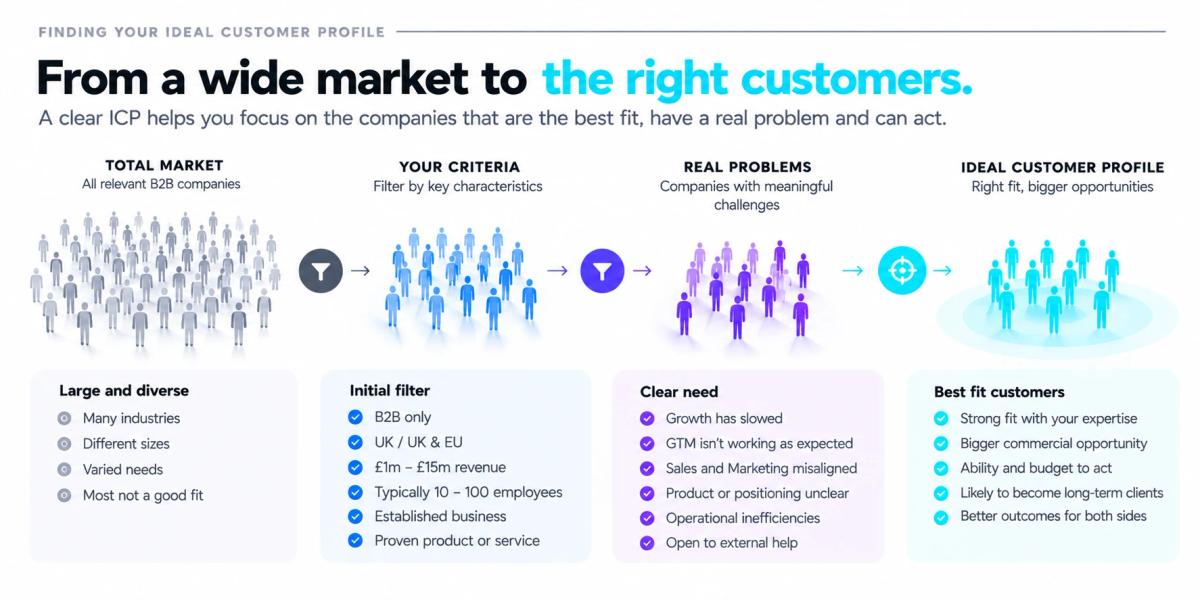
Rebuilding an ICP that Sales and Marketing both use
A useful ICP needs to work in the real commercial system. Sales should be able to use it when deciding which accounts deserve attention. Marketing should be able to use it for targeting and messaging. Product should understand which customers should carry more weight when evaluating requests.
That usually requires three types of information.
Firmographic fit describes what the organisation is: size, sector, geography, business model and other structural characteristics.
Situational fit describes what is happening: a growth event, regulatory pressure, new leadership, operational change, technology replacement or another trigger creating a reason to act.
Behavioural fit describes what the organisation does: how it researches, engages, buys, adopts and expands.
Put those together and an ICP becomes much more useful than a list of companies between two arbitrary revenue numbers. It becomes a commercial decision tool.
What to do if you're clearly targeting the wrong people
Don't change everything overnight. First establish where the evidence is strongest. Identify the segments producing the best combination of customer outcomes and commercial outcomes, then compare them with where your current sales and marketing effort is going.
That tells you where the mismatch is. You may discover that the market isn't wrong at all. Your positioning may be attracting the wrong part of it. Your acquisition channels may be skewing the audience. Sales incentives may be encouraging the wrong deals.
That's why changing an ICP shouldn't start with rewriting the ICP document. It starts with understanding who creates value for the business, who receives the most value from what you sell, and where those two things overlap.
That's the group worth building around.
Questions we get asked about this
What is an ideal customer profile?
An ideal customer profile describes the type of organisation where there is a strong combination of customer need, commercial fit and your ability to create value.
How do you know if your ICP is wrong?
Signals can include longer sales cycles, falling deal values, increased discounting, poor-fit leads and product requests pulling in unrelated directions. No single signal proves the ICP is wrong, but a pattern warrants investigation.
How often should an ICP be reviewed?
Review it when the business, market or customer economics materially change, and periodically compare the documented ICP with the customers actually producing the strongest outcomes.