Operational AI
If AI Becomes the Interface, Would You Still Build a Traditional App?
If users can increasingly express the outcome they want instead of navigating software to produce it, the interface changes. That has bigger implications for product design than simply adding a chatbot.
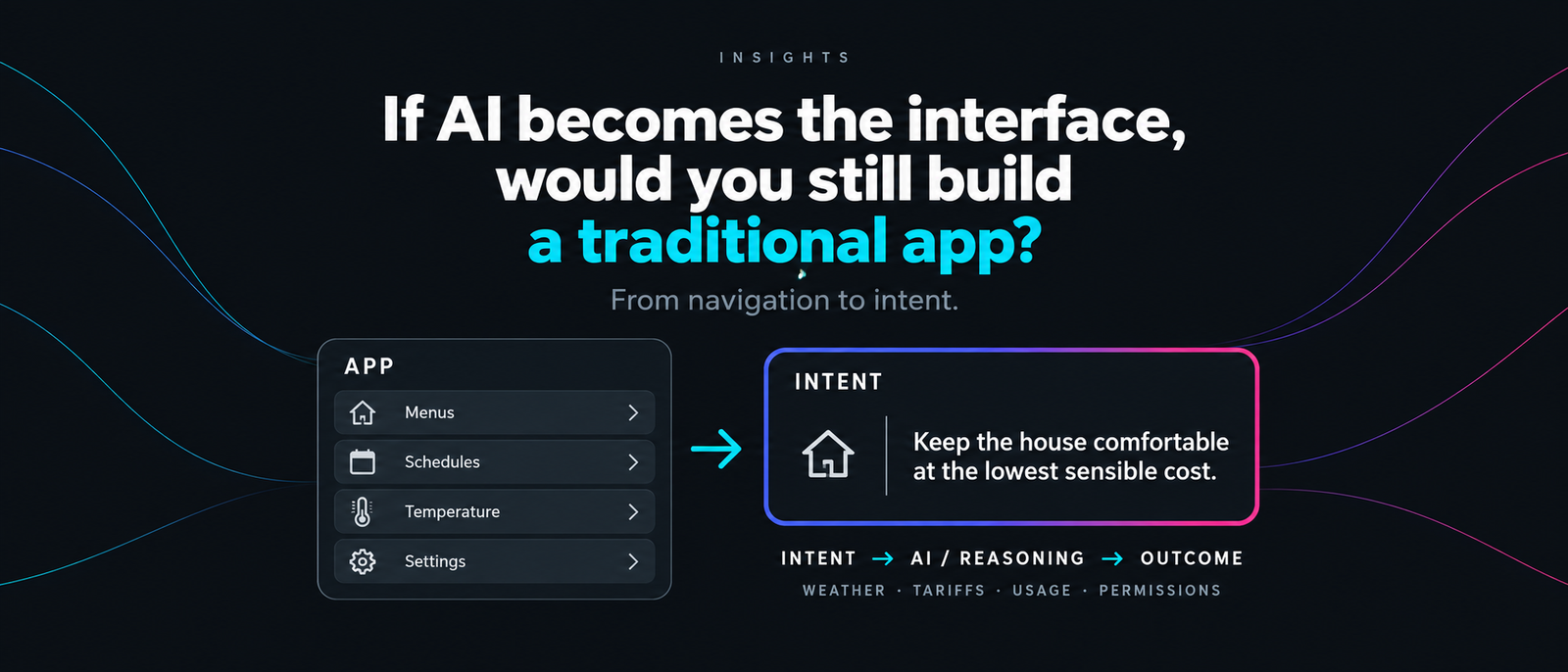
I have a Heatmiser system controlling the heating in my house. Like most connected systems, it comes with an app.
The app lets me select rooms, inspect temperatures, change targets and configure schedules. It works.
But I don't actually want an app.
I want a comfortable house at the lowest sensible cost.
The Heatmiser problem
The interface exists because I currently need to translate my desired outcome into a series of instructions the heating system understands.
I decide when rooms should be warm. I set temperatures. I change schedules when circumstances change. I check the weather mentally and decide whether the heating needs adjusting.
Now imagine the system has secure access to the information it needs: room temperatures, weather, tariffs, occupancy patterns, energy usage and the controls themselves.
Instead of configuring the system, I could express the outcome: "Keep the house comfortable when we're using it, but minimise the cost."
The system could determine the appropriate actions within boundaries I've approved.
That raises a much bigger product question. If software can increasingly understand intent, how much of the interface exists because users currently have to tell the system how to achieve an outcome rather than simply what outcome they want?
What the CRM would look like if it started today
Take CRM software.
Traditional CRM interfaces are built around records, fields, menus, pipeline stages, dashboards, filters and reports. Users learn the structure of the software and then navigate it to answer questions or complete work.
If I were designing some of those workflows from scratch today, I'd question whether navigation should remain the primary interface.
Instead of building a report, a sales leader could ask: "Which opportunities stalled this week and why?"
Before a meeting, an account executive could ask: "What do I need to know about this customer, what has changed since we last spoke and which commitments are still open?"
A commercial leader could ask: "Show me pipeline by region, explain the biggest changes since last month and flag anything that looks inconsistent."
The underlying CRM still matters enormously. In fact, the data model, permissions, relationships, workflow logic and auditability arguably become more important because the AI needs reliable systems underneath it.
What changes is the layer through which the user interacts with them.
Intent-based software: what it means and what it doesn't
AI-first does not mean chat-first.
Replacing every interface with a text box would be a terrible product strategy. Conversation is simply one mechanism for expressing intent.
An AI-native interface could combine voice, text, generated views, traditional controls, recommendations and actions. The important shift is from forcing the user to understand the software's structure towards allowing the system to understand more of the user's objective.
The traditional flow often looks like this: Navigate -> Find -> Configure -> Execute.
An intent-led flow can look more like this: State Intent -> System Reasons -> Presents or Acts -> User Confirms.
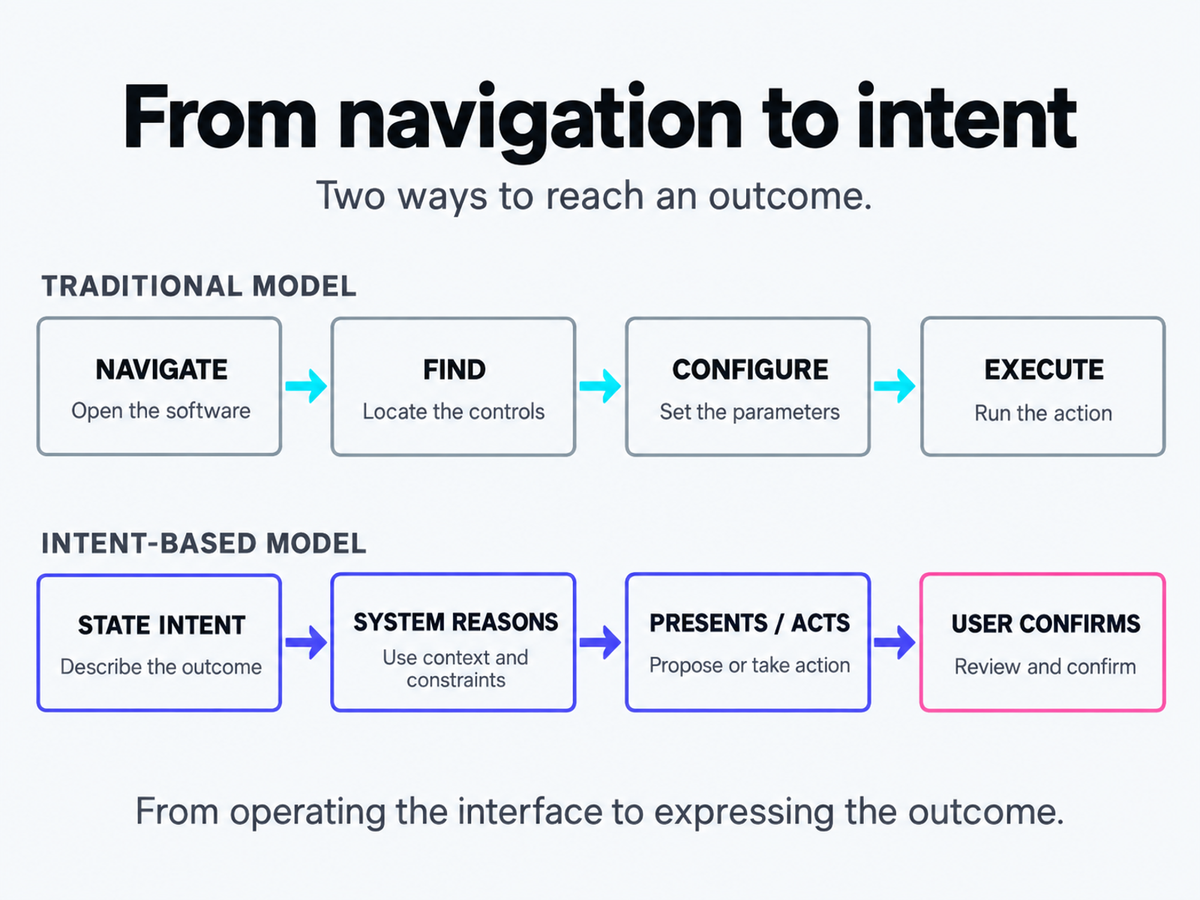
That doesn't remove the need for controls. It changes when and why they appear.
The three product decisions this changes
The first is what deserves a permanent interface. If a task is performed infrequently and can be expressed clearly as an outcome, a large dedicated workflow may become less necessary.
The second is where judgement sits. Some actions can be executed automatically within clear boundaries. Others should produce a recommendation for a human to review. Product teams need to design that boundary deliberately rather than assuming maximum automation is the goal.
The third is what becomes the product's durable value. If AI makes interfaces easier to generate and information easier to retrieve, defensibility moves further towards proprietary data, workflow integration, trust, domain logic, customer context and the quality of the underlying system.
That changes what product teams should prioritise.
Where traditional interfaces still win
There are plenty of situations where a conventional interface remains better.
Users may need to compare several things visually, manipulate detailed information, explore without knowing the exact question, perform precise creative work or understand the state of a complex system at a glance.
A financial modeller probably doesn't want every spreadsheet interaction converted into conversation. A designer needs direct manipulation. An operations team may need a persistent visual control surface during a live incident.
The future therefore isn't "no interfaces".
It's fewer interfaces that exist only because the software previously needed humans to translate intent into clicks.
That's the product question worth asking: if users could simply tell the system what they were trying to achieve, which parts of the interface would you still choose to build?
Questions we get asked about this
What is intent-based software?
Intent-based software allows users to express more of the outcome they want while the system determines or recommends the steps required to achieve it within defined permissions and controls.
Does AI-first software mean replacing interfaces with chatbots?
No. AI-first does not mean chat-first. Text and voice can be useful interfaces, but generated views, traditional controls, recommendations and direct manipulation can all remain part of the experience.
Will traditional software interfaces disappear?
No. Traditional interfaces remain valuable where users need precision, visual comparison, exploration, creative control or a persistent view of complex information.