Operational AI
Can AI Actually Reduce Your Costs? A B2B Reality Check
AI can reduce cost, but starting with the technology usually creates pilots rather than savings. Start with the workflow, baseline the economics, redesign the work and measure what actually changed.
"Where can we use AI?"
It's one of the most common questions businesses are asking. It's also usually the wrong place to start.
If you begin with the technology, almost every workflow becomes a potential AI use case. That produces pilots, licences and demonstrations. It doesn't necessarily produce a better business.
Start with the work instead.
Where AI genuinely earns its place
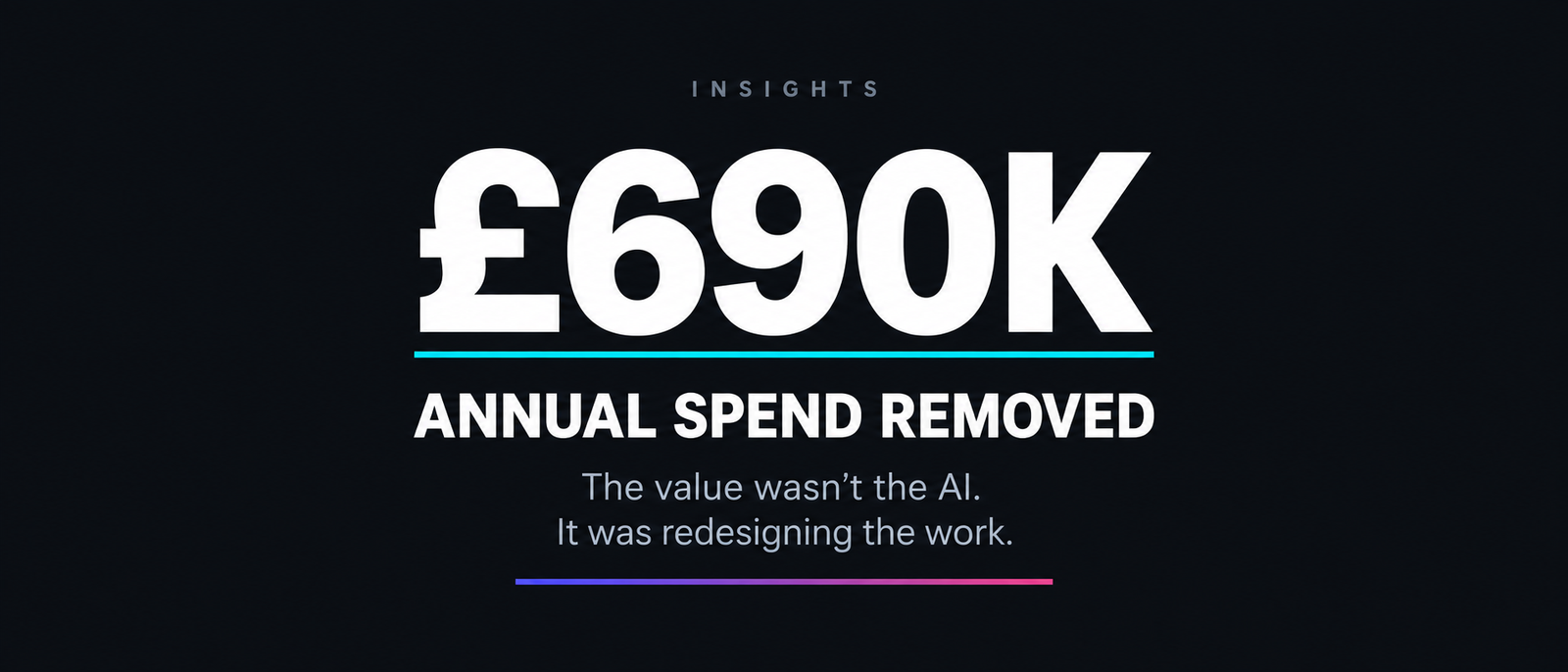
In one large organisation I worked in, redesigning and automating a workflow removed approximately £690,000 in annual spend.
The important part of that story isn't the AI. It's the workflow.
There was an existing process with an existing cost. We understood how the work happened, identified what was consuming resource, redesigned the process and used automation and AI where they improved the economics.
That's a very different approach from buying an AI platform and then looking for somewhere to use it.
The sequence I prefer is simple: Workflow -> Baseline -> Redesign -> Automate -> Measure.
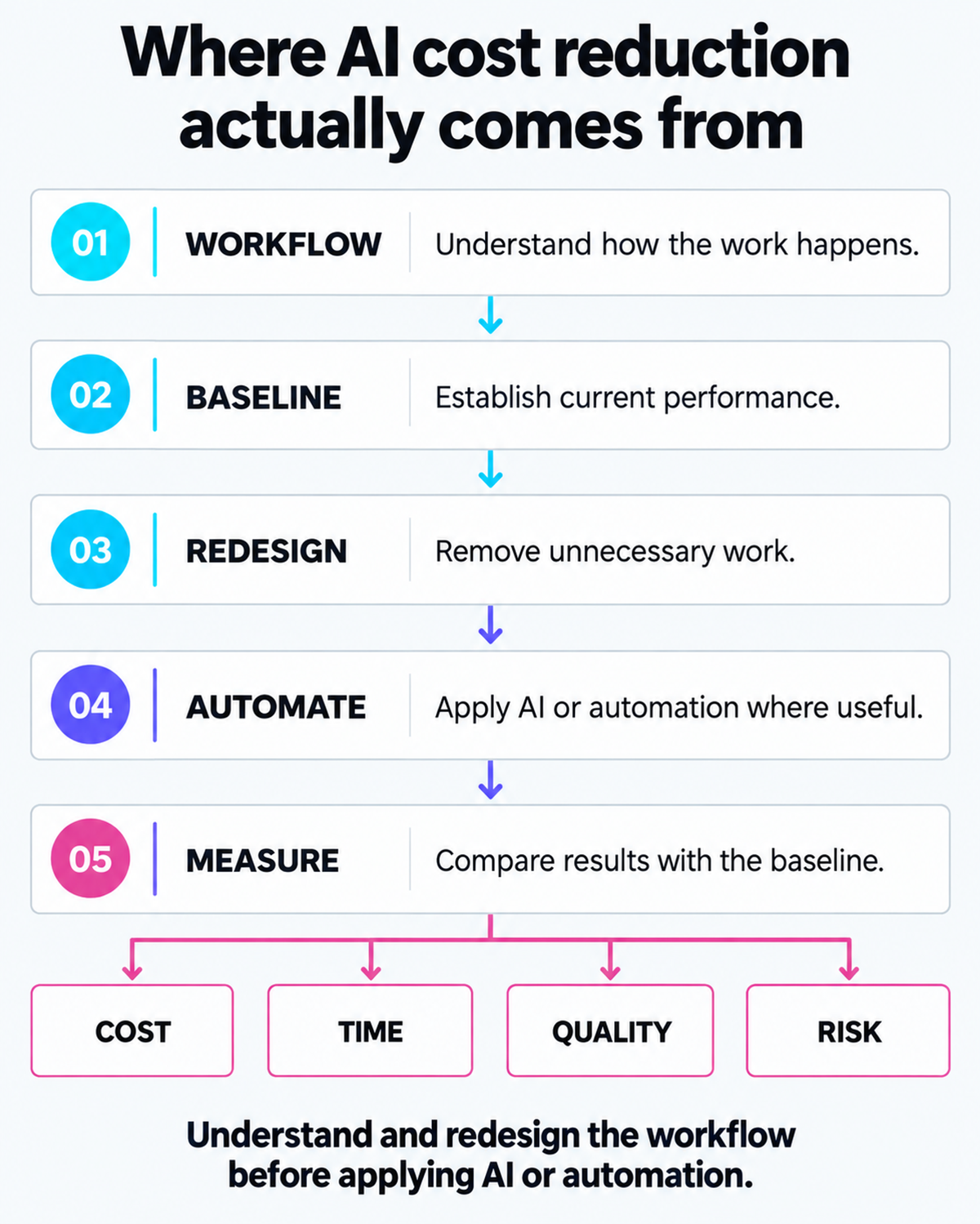
First understand the workflow as it operates today. Then establish what it costs, how long it takes, where quality varies and where risk is introduced.
Only then ask which steps can be removed, simplified, redesigned or automated.
Where AI adds cost without adding value
AI can make an inefficient process faster without making it better. That's not always an improvement.
A common failure mode is adding AI to a workflow nobody has questioned. Another is buying a broad platform because the organisation has decided it "needs AI", then trying to manufacture use cases to justify the licence.
Over-engineered personalisation is another example. Generating hundreds of content variations sounds sophisticated, but if the audience, proposition or underlying message is weak, AI simply produces more versions of something that wasn't working.
The same applies to customer-facing AI. A chatbot that adds another layer between a customer and the answer they need has automated friction rather than removed it.
The test is not whether AI is present. The test is whether the workflow performs materially better because of it.
The highest-value opportunities are usually hiding in the work
Rather than ranking generic AI use cases, look for operational characteristics that make a workflow worth investigating.
High-volume repetitive work is an obvious candidate, particularly where people spend significant time gathering, transforming, classifying or summarising information.
Look for repeated handoffs, manual re-entry, duplicated analysis, long waits between steps and processes where skilled people spend disproportionate time on low-judgement work.
Reporting is a good example. The opportunity may not be "use AI to write the report". The larger opportunity could be removing hours of manual extraction, reconciliation and preparation before anyone begins analysing the information.
Content operations can work the same way. Drafting may be the visible AI task, while the larger economic opportunity sits in translation, adaptation, approvals, versioning or repetitive production work.
Start with where time and money are actually being consumed.
What to try first if you have zero AI in your stack
Don't begin with an enterprise-wide AI transformation programme.
Choose one bounded workflow where you can establish a credible baseline. Map the current process, including the people involved, systems touched, time taken, cost, failure points and decisions requiring human judgement.
Then redesign the workflow before choosing the technology.
Some steps may disappear entirely. Some may be handled with conventional automation. Some may benefit from generative AI or machine learning. Others should remain human because judgement, accountability or relationship context matters.
Build the smallest useful version and run it against the existing process.
The objective isn't to prove that AI works. It's to establish whether the redesigned workflow works better.
Measuring the actual saving (not the theoretical one)
AI ROI becomes meaningless if the baseline is vague.
Measure the process before changing it. At minimum, understand cost, time, quality and risk.
If a workflow previously required 100 hours a month and now requires 40, establish what happened to those 60 hours. If people simply spend the saved time correcting AI output, the theoretical saving isn't real.
Quality matters for the same reason. Producing twice as much content isn't an efficiency improvement if performance declines or review effort doubles.
And cost needs to include the whole system: licences, implementation, integration, human review, governance, maintenance and the operating cost that remains.
The useful question isn't "How much AI are we using?"
It's "What became materially better, and can we prove it?"
Questions we get asked about this
Can AI genuinely reduce business costs?
Yes, when it removes or improves real work within a workflow. Savings should be measured against the cost, time, quality and risk of the process before the change.
How should a business choose its first AI use case?
Start with a bounded workflow that has measurable cost or inefficiency. Understand and redesign the process before deciding which parts need AI, conventional automation or human judgement.
How do you calculate AI ROI?
Establish a baseline before implementation, then compare the redesigned workflow across cost, time, quality and risk while including technology, implementation, review and ongoing operating costs.