GTM Leadership
The B2B GTM Stack Was Built for a Buyer Who No Longer Exists
B2B buying has changed faster than the systems used to measure it. The problem is not that MQLs or CRM stopped working, but that one person's activity rarely represents the whole buying process.
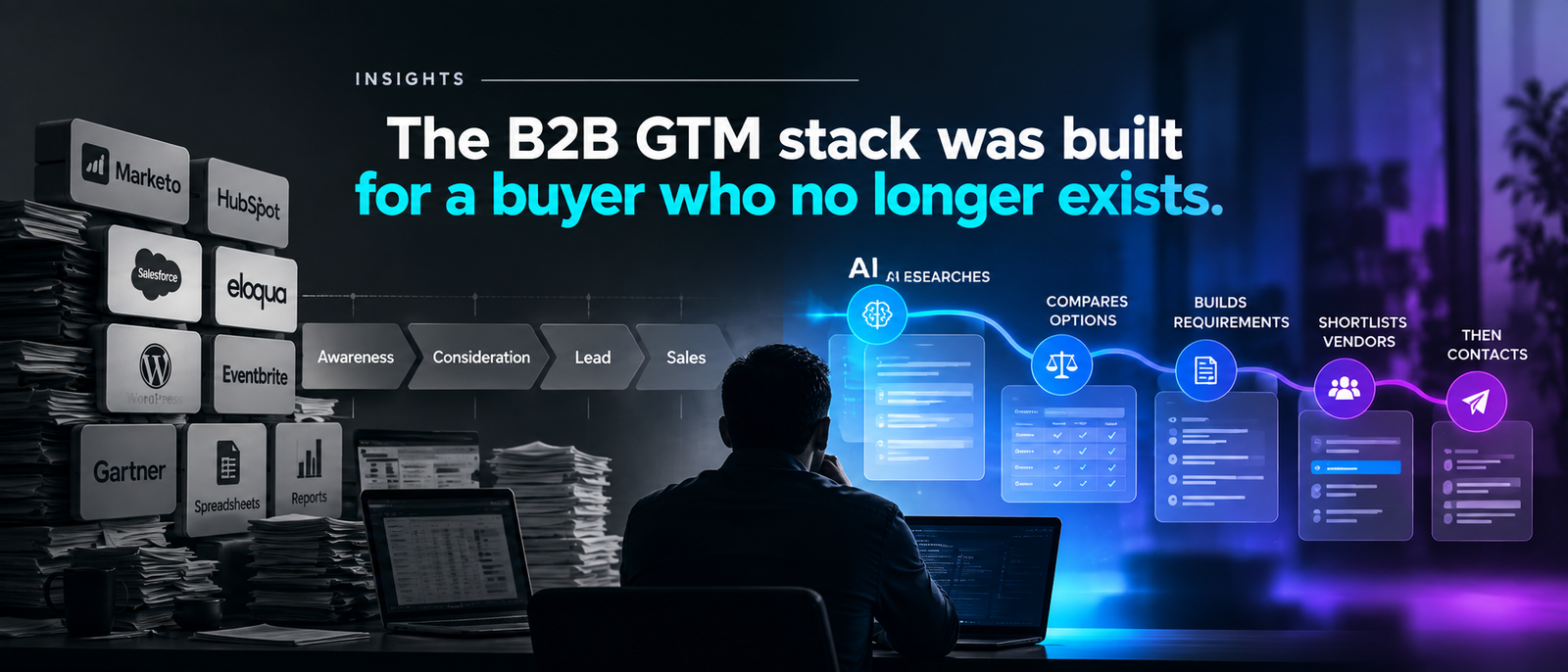
Most B2B go-to-market systems were designed around a fairly simple assumption: Marketing generates interest, identifies a lead, qualifies it and hands it to Sales. Sales then progresses that buyer through a defined process towards an opportunity and, hopefully, a deal.
That model hasn't disappeared. But it is a poor representation of how many B2B purchases actually happen today. A buyer can research a problem, compare approaches, investigate vendors, ask AI to build a shortlist and involve several colleagues before anybody fills in a form or speaks to Sales.
By the time one identifiable person appears in your CRM, a much larger buying process may already be underway. The problem isn't that your CRM, marketing automation or lead scoring platform suddenly stopped working. It's that we often ask those systems to represent a buying journey they weren't designed to see.
The buyer we designed the stack for
Traditional B2B demand generation is largely person-centric. Someone visits a website, downloads something and their behaviour is scored. Once the score reaches a threshold, they become an MQL. Sales accepts or rejects the lead and, if things progress, an opportunity is created.
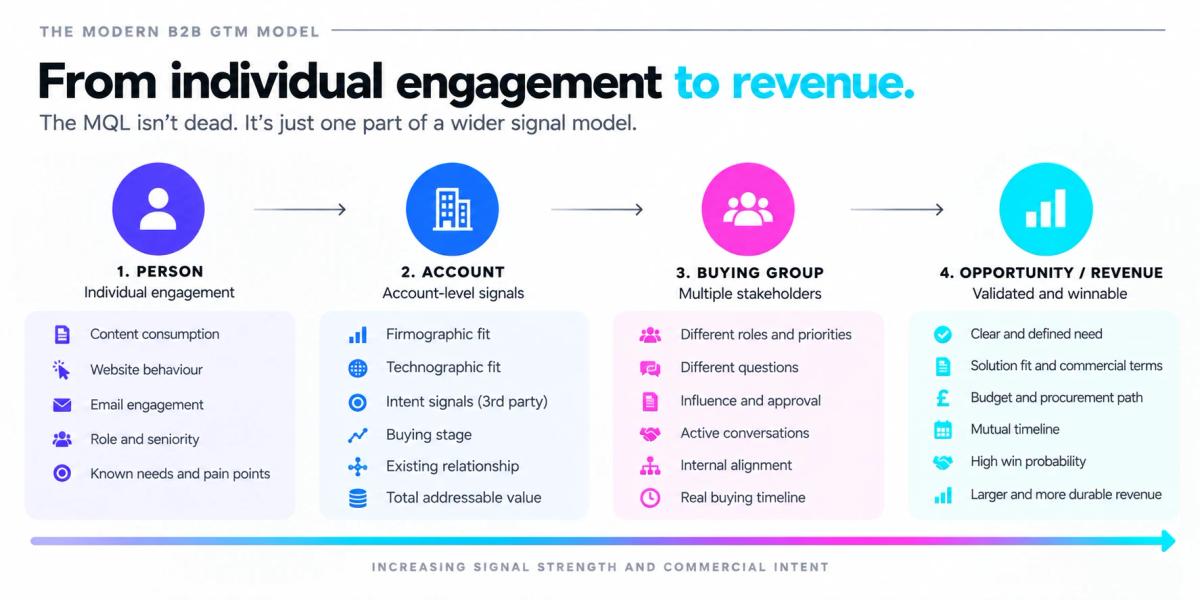
There is nothing inherently wrong with any of those signals. An MQL can still be useful. A form submission can still indicate intent. Lead scoring can still help teams prioritise activity. The mistake is treating one person's behaviour as if it represents the buying process.
Imagine an IT director researching a new platform. Procurement is checking suppliers. A technical lead is investigating integrations. Finance wants to understand the commercial case. A user is looking at reviews. Someone else asks an AI tool to compare three potential vendors.
Your CRM may see one contact. The customer has a buying group.
That's a very different thing.
What actually changed
Information has become much easier for buyers to obtain without speaking to the company selling the product. Vendor websites, review platforms, communities, analyst material, social content and search have progressively increased what buyers can discover independently. Generative AI adds another layer by allowing buyers to ask questions, compare approaches and structure requirements without navigating every vendor's content themselves.
That changes the role of marketing and sales. If a buyer can establish the basics independently, withholding useful information in exchange for an email address becomes less valuable. If several people are researching independently, measuring the journey through one person's activity becomes less reliable. And if a company enters your CRM relatively late, the absence of earlier first-party activity doesn't mean the buying journey only just started.
The modern B2B buyer journey hasn't become invisible. It has become distributed. Our measurement model needs to reflect that.
Where the current stack is now breaking
The first problem is identity. We tend to measure people while companies buy. A contact score can tell you that one person is engaged. It doesn't necessarily tell you whether their organisation is moving towards a decision.
The second problem is attribution. The easiest interactions to measure aren't necessarily the interactions that had the greatest influence. A tracked click may receive credit while a recommendation from a colleague, an AI-generated comparison or several weeks of independent research receives none.
The third problem is handoff. The traditional MQL-to-Sales model encourages organisations to decide that Marketing owns the buyer until a particular event occurs and Sales owns them afterwards. Buyers don't care about that internal boundary.
The fourth problem is optimisation. If the system measures individual leads, teams naturally optimise for generating more individual leads. That can produce impressive activity metrics without producing more buying organisations or more revenue.
What replaces it: our POV
The answer isn't to throw away MQLs, CRM or attribution. It's to stop asking any one of them to tell you the whole story.
A more useful B2B GTM model combines signals at several levels: person, account, buying group, opportunity and revenue. Individual engagement still matters, but it sits alongside account behaviour, known relationships, product usage where relevant, commercial context, intent and actual progression through the buying process.
This also changes the relationship between Sales and Marketing. Rather than Marketing generating a lead and throwing it over a wall, both functions should be looking at the same commercial picture and deciding what the evidence suggests should happen next.
Sometimes that's a sales conversation. Sometimes it's another piece of content. Sometimes it's product access. And sometimes the correct action is nothing yet.
The objective isn't to create more handoffs. It's to help the right organisations progress.
How to test whether your stack is broken
Start with five questions.
- Can you see meaningful activity at account level, or mainly at contact level?
- Can Sales see why an account appears to be interested, not just that a lead has been scored?
- Do Marketing and Sales work from a shared view of the buying organisation?
- Can you connect your GTM activity to opportunities and revenue without pretending every influence is perfectly attributable?
- Are you optimising for more leads, or for more of the right organisations becoming customers?
If those questions are difficult to answer, buying behaviour may have moved faster than the GTM system around it. That doesn't automatically mean buying more technology.
It usually means understanding the journey first, deciding which signals actually matter, and then designing the process, data and tooling around them.
Questions we get asked about this
Are MQLs dead?
No. An MQL can still be a useful signal. The problem is treating one person's score or behaviour as if it represents an entire B2B buying process.
What is a buying group?
A buying group is the collection of people involved in researching, evaluating, influencing or approving a purchase within an organisation.
Does modern B2B GTM require replacing the CRM?
Not necessarily. The first step is understanding the buying journey and the signals that matter. Existing systems can often support a better model once the process and data have been redesigned.