Product
Why Aren't Customers Using Your New Features? Adoption Root Causes
Low feature adoption is not one problem. Find where users disappear between eligibility, discovery, activation, value and repeat usage before deciding what to change.
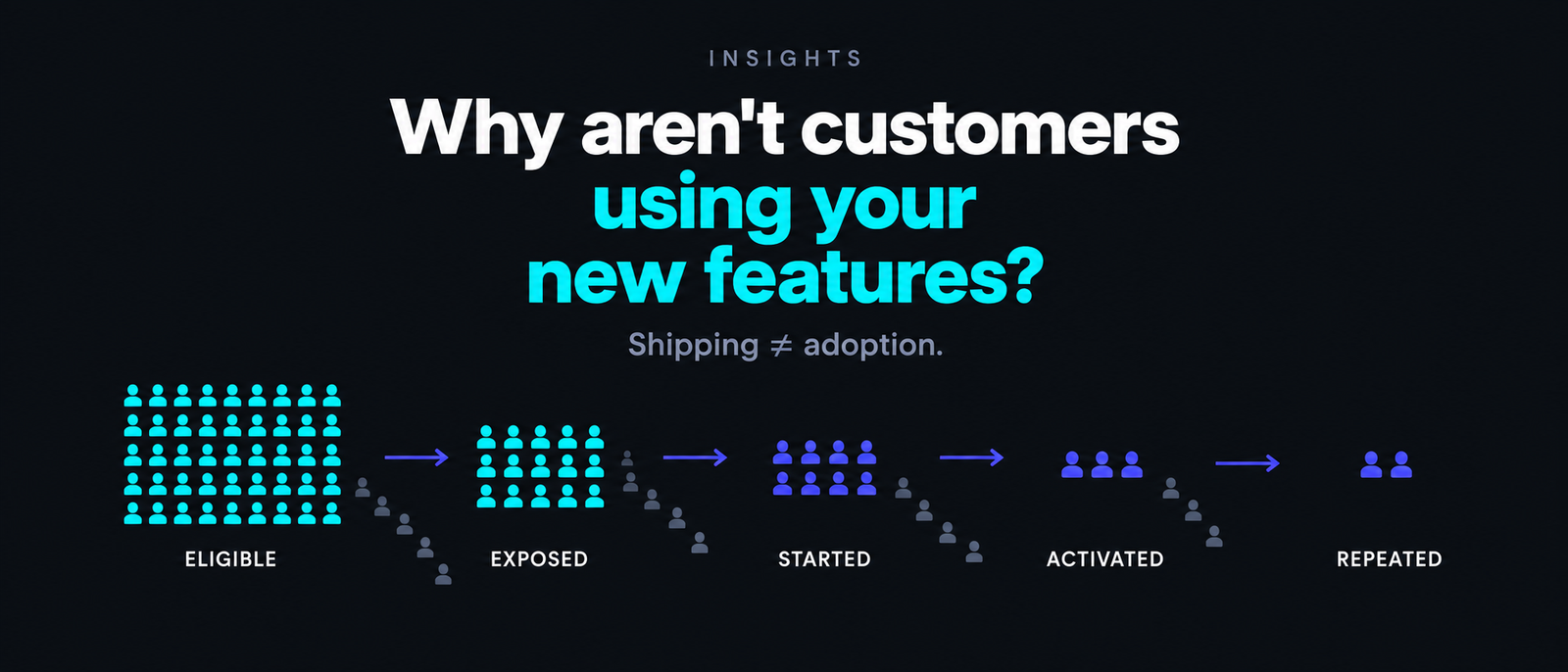
You researched it, designed it, built it and shipped it. Customers asked for it. Then hardly anybody used it.
The temptation is to conclude that the feature was wrong. Sometimes it was. But low adoption can happen at several different points between launch and repeat usage, and each failure requires a different response.
The useful question isn't simply "Why is adoption low?" It's "Where exactly are users disappearing?"
The four adoption failure modes
Think about feature adoption as a sequence: Eligible -> Exposed -> Started -> Activated -> Repeated.
That creates four useful diagnostic gaps.
- A discovery gap means relevant users don't encounter or understand the feature.
- An activation gap means they see it but don't start or complete the initial experience.
- A value gap means they use it but don't achieve an outcome worth returning for.
- A retention gap means they experience initial value but the behaviour doesn't become repeatable.
Calling all four an "adoption problem" hides the information you need to fix them.
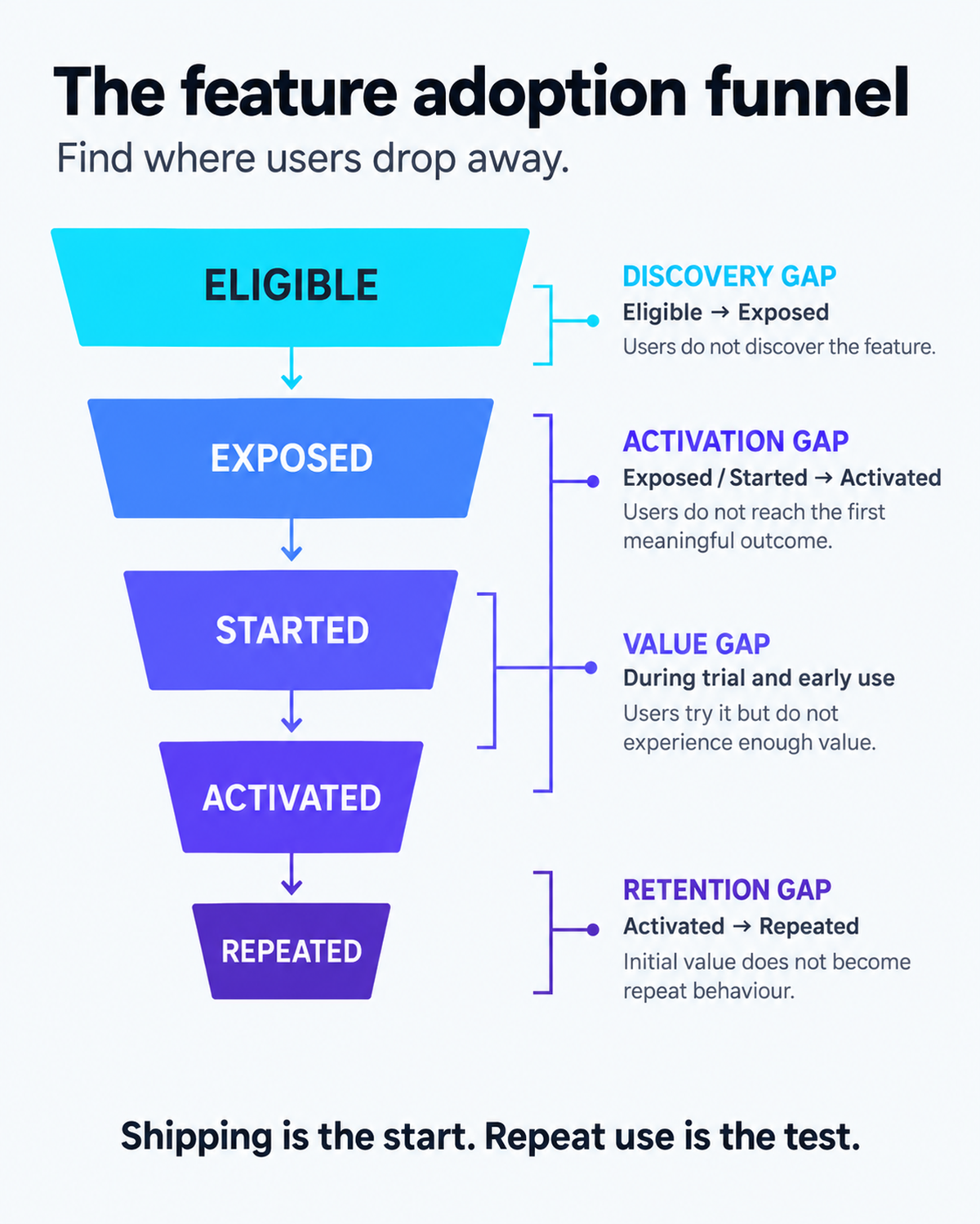
Discovery, activation or value gap?
Start by identifying the first significant drop. If only a small proportion of eligible users ever encounter the feature, changing functionality may achieve nothing. The problem may be navigation, onboarding, communication or context.
If users discover it but don't start, investigate perceived value and the effort required. If they start but don't reach the intended outcome, look at the experience itself. Is setup too difficult? Does the feature fail to solve the problem as expected? Does the user need data, permissions or behaviour from somebody else?
And if customers achieve the outcome once but don't return, ask whether the problem occurs frequently enough to support repeated usage.
Different gap, different fix.
When you shipped what customers said vs what they needed
Customers are extremely useful at describing problems. They aren't always the best people to design the solution.
A customer might ask for a dashboard because they need better visibility. Build the dashboard exactly as requested and you may discover that nobody uses it because the actual problem was receiving an early warning when something went wrong.
The request was real. The proposed solution wasn't necessarily the need.
Product discovery should therefore keep asking what the customer is trying to achieve, what happens today and why the current approach fails. That's how you avoid turning a feature request into a specification before understanding the underlying problem.
Instrumenting adoption properly
Measure the journey, not just feature usage. Define who is eligible. Measure who encounters the feature. Track meaningful starts. Identify the event that represents value. Then measure whether the behaviour repeats at an appropriate interval.
The exact metrics depend on the feature. A monthly reporting workflow shouldn't be judged using daily active usage. A configuration feature may only need to be used once. A collaboration tool probably requires repeated behaviour from several users.
Instrumentation should reflect the job the feature exists to perform.
What to change before shipping the next feature
Don't respond to poor adoption by adding more features. Take the evidence back into discovery.
Understand where the adoption journey failed, what assumptions proved wrong and whether the original customer problem still exists. Then decide whether to improve discovery, reduce activation friction, strengthen the value delivered, change the feature or stop investing in it.
Shipping is not the end of product development. It's the point where some of your most useful evidence finally becomes available.
Questions we get asked about this
Why do customers not use new product features?
Low adoption can come from users not discovering the feature, failing to activate it, not receiving enough value or not having a reason to use it repeatedly.
How should feature adoption be measured?
Measure the journey from eligible users through exposure, starting, reaching meaningful value and repeating the behaviour where repeat usage is appropriate.
Does low adoption mean the feature was a bad idea?
Not necessarily. Low adoption can result from discovery, onboarding or activation problems even when the underlying feature solves a valuable customer problem.